Immediate Forklift Truck Driver Jobs in Leeds Logistics Hub, LS9
Join one of Leeds’s premier logistics sites for an immediate start. Staffing Agency is recruiting skilled Forklift Truck Drivers for ongoing, flexible work in the heart of the city's supply chain. Competitive pay, weekly payments, and professional support await.
Primary Location
Leeds LS9
Logistics Hub & surrounding areas
Start Date
ASAP
Roles available immediately
Pay Structure
Competitive
Weekly pay, based on experience
Contract Type
Temporary
Temp-to-perm opportunities available
Forklift Truck Driver Job Description: Leeds Logistics Hub
Staffing Agency is the trusted partner for logistics recruitment across Yorkshire, connecting talented Forklift Truck Drivers with leading employers at the Leeds Logistics Hub in LS9. Our client, a major player in UK distribution and warehousing, requires experienced drivers for an immediate temporary assignment to support their expanding operations. This is a pivotal role within a fast-paced environment where safety, precision, and efficiency are paramount.
By applying through our specialised forklift operator division, you gain access to vetted roles that match your skills and career goals. We handle the compliance, payroll, and liaison, allowing you to focus on delivering excellent work. This position offers not just a job, but a pathway to ongoing logistics roles and potential permanent placement for standout performers.
Explore our dedicated logistics staffing services and hear from our drivers.
At a Glance
- Role: Forklift Truck Driver (Counterbalance/Reach)
The Complete Skills Profile: What Makes a Top-Tier Leeds Forklift Driver
Beyond holding a valid licence, the most sought-after drivers in the LS9 hub possess a blend of technical proficiency, soft skills, and situational awareness. Understanding this profile can help you assess your fit and identify areas for development.
Technical & Certifiable Competencies
-
Multi-MHE Certification
Drivers certified on multiple truck types (e.g., Reach, Counterbalance, and Bendi) are instantly more valuable. Specialisation in VNA or Combi trucks commands premium rates. We recommend drivers consider sequential certification to broaden their assignment opportunities.
-
WMS & RF Technology Fluency
Proficiency with common Warehouse Management Systems like SAP, Oracle, or Manhattan, and their handheld RF devices is crucial. This includes error logging, cycle counting, and handling complex pick paths. Many Leeds sites now also use voice-picking or smart glasses technology.
-
Load Planning & Securing Expertise
Knowledge of advanced load securing methods for non-standard shapes, understanding of axle weight distributions for outbound loads, and the ability to plan an efficient loading sequence for a 44-tonne artic are skills that distinguish operational experts.
Critical Soft Skills & Behaviours
-
Situational Communication
The ability to communicate clearly via radio in a noisy environment, to de-escalate a conflict with a HGV driver over a loading bay, or to effectively hand over information at shift changeover is invaluable. It ensures safety and maintains workflow.
-
Proactive Problem-Solving
When a pallet is damaged, a location is mis-scanned, or a truck develops a fault, the best drivers don't just report it—they propose a safe, efficient solution. This proactive mindset reduces downtime and is highly prized by site managers.
-
Pacing & Fatigue Management
A 10-hour shift on a forklift is physically and mentally demanding. Top drivers manage their energy, stay hydrated, take proper breaks, and maintain consistent output without burnout. This sustainability makes them reliable long-term assets.
The Future of Forklift Driving in Leeds: Automation, Technology & Career Longevity
The LS9 logistics landscape is not static. Drivers who understand emerging trends can position themselves for continued relevance and career growth in an evolving industry.
Embracing Technology, Not Fearing It
Co-Bots & Assisted Systems
Many new Leeds facilities are deploying collaborative robots ("co-bots") that work alongside drivers. For example, automated pallet movers that transport goods from packing stations to the loading bay, where the driver takes over for final loading. Understanding how to interface with these systems is a new, valuable skill.
SKILL TO DEVELOP: Robotic System Interface BasicsData & Analytics Awareness
Modern forklifts are data hubs, tracking metrics like travel distance, energy use, and impacts. Drivers are increasingly expected to engage with this data, participating in daily performance huddles to discuss efficiency metrics and safety scores. This analytical shift moves the role from pure operation towards operational management.
SKILL TO DEVELOP: Basic Performance Metric LiteracyElectric Vehicle (EV) Transition
The shift from LPG to electric forklifts is accelerating in Leeds due to sustainability goals. This requires knowledge of battery management, opportunity charging procedures, and different handling characteristics (e.g., instant torque, quieter operation). Experience with electric MHE is becoming a notable advantage on a CV.
SKILL TO DEVELOP: Electric MHE Operation & MaintenanceCase Study: Sarah's Upskilling Journey – From Driver to"Smart Logistics Technician"
Sarah, a Reach Truck driver placed by Staffing Agency at an LS9 e-fulfilment centre, expressed interest in the new automated goods-to-person systems being installed. Our agency, in partnership with the client, facilitated her enrolment in a short, certified course on"Fundamentals of Warehouse Automation".
The Opportunity
The client needed a liaison between the traditional warehouse team and the automation technicians—someone who understood both the physical workflow and the new technology. Sarah's proactive upskilling made her the ideal candidate.
The Outcome
Within 9 months, Sarah transitioned from a temp driver to a permanent"Flow Technician" role. She now oversees a zone where robots bring pods to manned picking stations, troubleshoots minor system faults, and trains other drivers on the new processes, with a 22% salary increase.
A Guide to Warehouse Cultures in the LS9 Hub: Finding Your Best Fit
Not all warehouses operate the same. The culture, pace, and expectations can vary dramatically between sectors. Understanding these nuances helps us place you where you'll thrive.
| Sector | Typical Pace & Environment | Key Driver Attributes | Potential Challenges |
|---|---|---|---|
|
E-commerce Fulfilment (e.g., fashion, general retail) |
Extremely fast-paced, especially during peak (Black Friday, Christmas). High noise levels, constant"pick and pack" pressure. Often a younger workforce. |
|
Can be repetitive. Performance metrics (picks per hour) are tightly monitored. |
|
Food & Beverage (FMCG) (e.g., supermarkets, distributors) |
Hygienic, often chilled or ambient. Pace is steady but governed by strict delivery windows to stores. Heavy focus on use-by dates and stock rotation (FIFO). |
|
Early morning starts common. Strict hygiene rules (hairnets, no jewellery). |
|
Industrial & Manufacturing (e.g., automotive, building materials) |
Slower, more deliberate pace focused on handling heavy, bulky, or high-value items. Strong safety culture. Often involves complex load builds for production lines. |
|
Less frequent"quick win" tasks. Can involve longer periods of concentration. |
Financial Navigation for Agency Drivers: Maximising and Managing Your Earnings
As a temporary driver, managing your finances effectively is key. Here’s a detailed look at earnings potential and smart financial practices.
Real-World Earnings Scenarios
Scenario A: Standard 40-hour Week (Days)
Base: 40 hrs @ £13.50/hr (Reach Truck, PAYE)
Weekly Gross: £540.00
After tax & NI (approx.): ~£430-£450 net
Scenario B: Week with Overtime & Night Shift
- Base Nights: 40 hrs @ £15.50/hr = £620
- Saturday OT: 8 hrs @ £23.25/hr (1.5x) = £186
- Sunday OT: 6 hrs @ £23.25/hr = £139.50
Weekly Gross: £945.50
After tax & NI (approx.): ~£700-£730 net
Smart Financial Practices for Temp Workers
-
Budget for the Gaps
While we strive for continuous placements, it's prudent to save a portion of your weekly pay to cover potential short breaks between assignments. Aim for a buffer equivalent to 2-3 weeks' net pay.
-
Understand Your Payslip
Review your weekly payslip carefully. Ensure your tax code is correct (usually 1257L), and you understand deductions for National Insurance and pension auto-enrolment. Your consultant can explain any line item.
-
Invest in Career Capital
Consider using a portion of your earnings to fund additional certifications (e.g., ADR for hazardous goods, First Aid at Work). This investment can open doors to higher-paying, niche roles within the Leeds hub.
Beyond the Licence: A Holistic Guide to Health, Safety & Wellbeing on Shift
Safety is the absolute priority. This section expands on the physical and mental wellbeing practices that sustain a long, healthy career as a professional driver.
Preventing Common Physical Strains
Whole-Body Vibration
Prolonged exposure from sitting on a moving forklift can cause back pain. Mitigate by ensuring correct seat adjustment, using suspension seats if available, and taking micro-breaks to stand and stretch every hour.
Repetitive Strain & Fatigue
Constant neck twisting to look upwards in high-bay racking, and repetitive hand movements for controls and scanners, are risks. Practice ergonomic techniques, vary tasks if possible, and report any discomfort early.
Shift Work Sleep Disruption
Night shifts disrupt circadian rhythms. Invest in blackout curtains, maintain a cool bedroom temperature, and establish a consistent pre-sleep routine even on days off. Avoid heavy meals and caffeine before sleeping.
Mental Wellbeing & Professional Pride
The role of a forklift driver is skilled and critical. Combatting any stigma around"just being a temp" is important.
- iDefine Your Value: You are a certified professional operating complex machinery worth tens of thousands of pounds, responsible for millions of pounds of stock and the safety of everyone around you.
- iSeek Feedback & Growth: Proactively ask site supervisors for constructive feedback. Use it to improve. This mindset transforms a temporary role into a continuous professional development exercise.
- iBuild Your Network: Every assignment is a chance to build your professional network. Positive relationships with site managers and permanent staff can lead to direct job offers or stellar references for future roles.
Your Pre-Application Checklist & Next Steps
To ensure the fastest possible start, use this checklist to prepare before you apply. Having these items ready will slash your onboarding time.
Documents & Information to Gather NOW
- Digital Copies: Clear photos/PDFs of your Forklift Licence (front & back), Passport (photo page), and Proof of Address (utility bill/bank statement < 3 months old).
- National Insurance Number: Have your NI card or letter to hand.
- Bank Details: Account number and sort code for the account you want paid into.
- Reference Contacts: Names, companies, job titles, and contact details for your last 2 warehouse/manufacturing employers.
- Availability Calendar: Be clear on which shift patterns you can work (Days/Lates/Nights/Weekends) and any pre-booked unavailability.
Immediate Actions After Reading This Page
- 1 Self-Assess: Re-read the"Skills Profile" and"Warehouse Cultures" sections. Honestly assess your strengths and preferred environment.
- 2 Gather: Start collecting the documents from the checklist. Put them in a dedicated folder on your phone or computer.
- 3 Decide: Choose your preferred method of initial contact – the online application for speed, or the direct phone call for an immediate conversation.
- 4 Act: Click"Apply Now" or dial 020 8629 1195. The first step is the most important. Our team is ready to connect you with your next opportunity in Leeds LS9.
The Machinery of Modern Logistics: A Deep Dive into Leeds's Forklift Fleet
The Leeds LS9 hub is a testing ground for the latest Material Handling Equipment (MHE). Understanding the specific capabilities and niches of each truck type is not just about operation—it's about maximising your efficiency and value on site. This section breaks down the fleet you're likely to encounter.
Beyond Counterbalance and Reach: The Specialists
While Counterbalance and Reach trucks form the backbone, sophisticated operations demand specialist machines. Knowledge of these can set you apart.
Bendi / Flexi Trucks
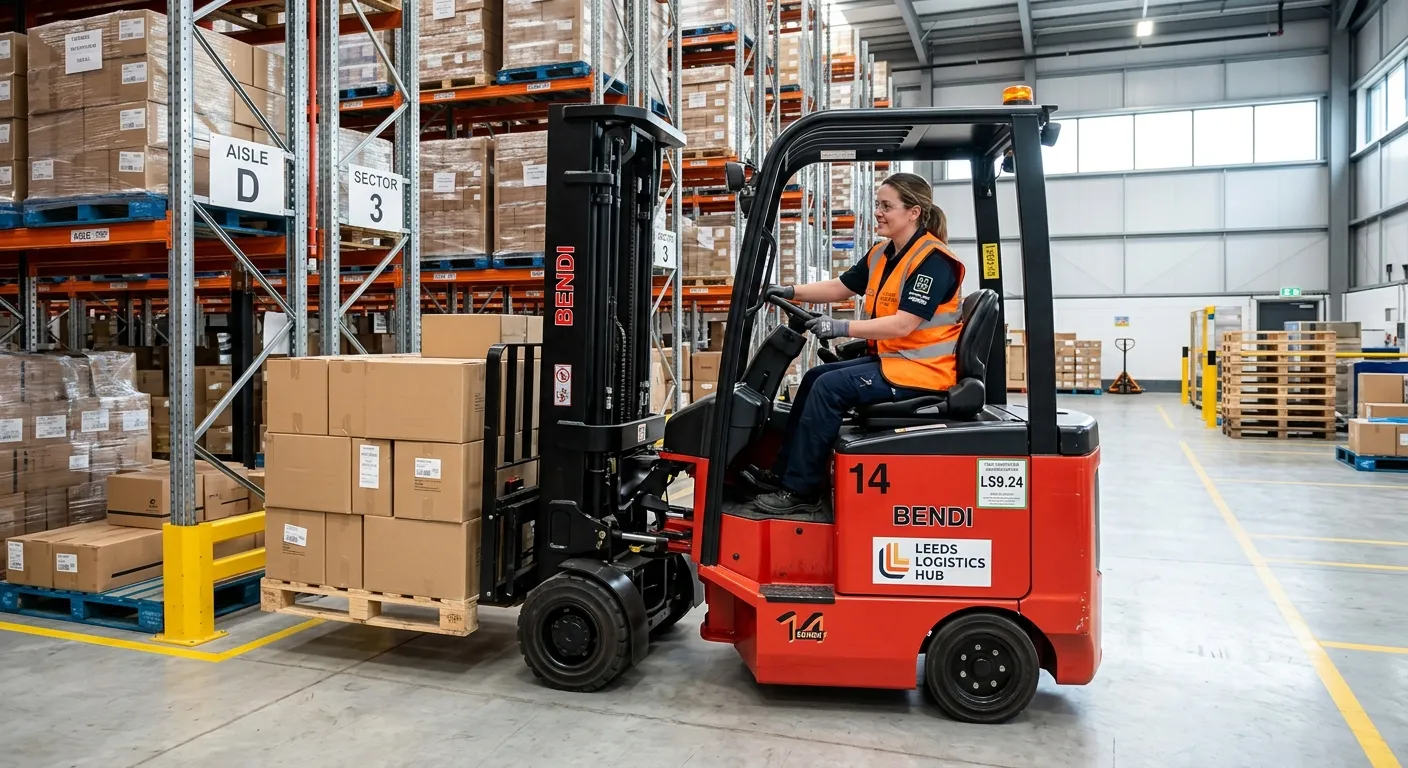
The hybrid workhorse. A Bendi truck combines the manoeuvrability of a reach truck (it can operate in aisles as narrow as 1.6m) with the ability to work outdoors like a counterbalance, as its front wheels pivot 90 degrees. It’s the perfect solution for sites with mixed internal racking and external yard work.
LEEDS APPLICATION: Common in retail distribution centres where drivers transition from unloading yard vehicles directly into narrow-aisle put-away without changing machines.
Pallet Stackers & Order Pickers
Often underrated, these are critical for specific tasks. Powered pallet stackers are agile for horizontal transport, while man-up order pickers elevate the operator to picking height for case-level selection. This role requires a head for heights and exceptional attention to detail.
LEEDS APPLICATION: Essential in e-commerce fulfilment centres for single-item picks and in parts distribution for intricate order assembly.
Very Narrow Aisle (VNA) Turret Trucks
The kings of high-density storage. VNA trucks operate in aisles barely wider than the load, with a rotating turret that allows the forks to turn 90 degrees left or right without the truck turning. They service racking over 15m high. Operation requires intense concentration, spatial awareness, and often involves wire or rail guidance systems.
LEEDS APPLICATION: Found in high-bay automated storage and retrieval systems (ASRS) for sectors like pharmaceuticals or high-value electronics, where space is at a premium.
Side Loaders & Combi Trucks
Designed for handling long, awkward loads like timber, piping, or sheet materials. The forks are mounted on the side, allowing the truck to travel down an aisle carrying a load parallel to its direction of travel. Combi trucks can convert between side-loading and front-loading configurations.
LEEDS APPLICATION: Prevalent in the industrial and manufacturing sites around LS9, particularly those supplying the construction and engineering sectors.
Mastering the Unwritten Rules: Warehouse Protocols & Communication Systems
Every warehouse has its own culture, but successful integration requires understanding the universal and site-specific codes of conduct, safety signals, and communication hierarchies that keep operations flowing smoothly and safely.
The Non-Negotiables: Universal Safety Protocols
-
Pedestrian Priority & Right of Way
The golden rule. Pedestrians always have the right of way. This means coming to a complete stop at aisle intersections, sounding the horn, and making eye contact. In busy LS9 hubs, designated pedestrian walkways are marked—never drive in them, even if empty.
A common cause of near-misses is reversing without a banksman (signaller). The rule is: if you cannot see, you must have a guide or use approved camera systems.
-
Load Height & Overhead Clearance
A critical, often overlooked protocol. Drivers must know the exact mast height of their loaded truck and the clearance heights of every door, pipe, and sprinkler head on their route. Many Leeds sites have a"lowest point" map. Striking an overhead object is a major safety and operational incident.
-
Parking &"Key-Off" Discipline
When dismounting for more than 5 minutes, the protocol is universal: lower forks fully, apply the parking brake, turn the key off, and remove it. In neutral areas, forks must be positioned to avoid creating a trip hazard. This discipline prevents unauthorised use and accidental movement.
Communication: Radios, Hand Signals, and Shift Handovers
Radio Etiquette in a Noisy Environment
Warehouse radios are for concise, clear operational communication. Learn the phonetic alphabet (“Alpha, Bravo, Charlie”) for spelling locations. Begin messages with the recipient's call sign and your own. Avoid jargon and never use for casual chat. A typical exchange:
"Control, this is Driver 7. Pick for order 45B is complete at station Delta. Over."
"Driver 7, Control. Roger that. Proceed to loading bay 3 for trailer load-out. Over."
"Control, Driver 7. Wilco. Out."
The Critical Role of Shift Handover
A professional handover prevents errors and delays. It’s not just clocking out. It involves informing the incoming driver of: MHE with faults or low battery, incomplete tasks or priority picks, any stock anomalies (damage, mis-location), and current traffic hotspots in the warehouse. Many sites use a digital or paper handover log we insist you complete diligently.
Seeing the Bigger Picture: How Your Role Impacts the Supply Chain
Exceptional drivers understand they are not just moving pallets; they are executing critical nodes in a vast supply chain. This knowledge fosters pride and improves decision-making. Here’s what happens upstream and downstream of your role in Leeds.
From Supplier to Shelf: The Chain You Support
Inbound Logistics: The Receiving Challenge
When you unload a container, you are the first point of quality control for goods that may have travelled thousands of miles. A delay here causes a domino effect: the HGV driver misses his window, production lines wait for components, and put-away teams stand idle. Your efficiency directly reduces demurrage charges (fees for delayed containers) for the client, saving them thousands.
YOUR IMPACT: Accurate scanning on receipt updates the WMS in real-time, telling planners stock is available to sell. A missed scan can mean lost sales.
The Picking Imperative: Order Accuracy = Customer Satisfaction
In an e-commerce site, a single mis-pick has a ripple effect. An incorrect item sent to a customer means: a frustrated customer call, a costly reverse logistics process (returns), re-picking the correct item, and potential loss of that customer for life. Your 99.9% accuracy target isn’t arbitrary; it’s directly tied to the company’s profitability and reputation.
YOUR IMPACT: In FMCG, picking the correct batch code and ensuring FIFO (First-In, First-Out) is a legal requirement for traceability, crucial in food safety.
Outbound & Loading: The Final Hurdle
Loading a 44-tonne artic for a multi-drop route is a 3D puzzle. Incorrect load planning (heaviest at the back) can make the vehicle unstable. Loading deliveries in reverse order causes massive delays at drop points. Your skill in building a stable, accessible load directly influences on-time deliveries to Leeds stores and beyond, impacting the client’s key performance indicators (KPIs) with their customers.
YOUR IMPACT: Proper load securement prevents in-transit damage, which can wipe out the entire margin on that delivery.
Advanced On-Shift Problem Solving: A Framework for Drivers
Things go wrong. The best drivers are not flustered; they follow a logical, safe process to resolve issues. This framework empowers you to handle common problems professionally, minimising downtime.
Scenario 1: RF Scanner / WMS Failure
Symptoms: Device freezes, won't scan, shows"connection lost" or gives illogical instructions.
Your Action Plan:
- Basic Reset: Restart the scanner (usually a soft reset).
- Location Check: Move to an area with known good Wi-Fi/radio signal.
- Manual Process: Inform your supervisor immediately. They will initiate a manual paper-based pick/put-away process. Do not guess or proceed without instruction.
- Log Details: Note the scanner ID, error message, time, and location for the IT team.
Scenario 2: Discovered Stock Damage or Discrepancy
Symptoms: Crushed carton, liquid leak, incorrect quantity in location, or wrong product in pallet.
Your Action Plan:
- Isolate & Secure: Safely move the affected goods to a designated quarantine area if possible. If leaking, follow site spill procedures.
- Do Not"Fix" It: Never try to hide damage or move stock to"correct" a count without authorisation. This corrupts inventory data.
- Report Precisely: Use the correct code in the WMS (e.g.,"DAM,""SHRTG,""OVRG") and alert your supervisor with location, product code, and photo if allowed.
- Update Documentation: Ensure any paper or digital trail reflects the find.
Scenario 3: Forklift Performance Issue
Symptoms: Unusual noise, reduced power, warning light, hydraulic leak, or brake irregularity.
Your Action Plan:
- Immediate Cessation: If it's a safety-critical fault (brakes, steering), stop operating immediately in a safe place.
- Defect Tagging: Complete a"Defect" or"Out of Service" tag (often red). Attach it to the key or steering wheel.
- Detailed Report: Log the fault in the truck's maintenance book with time, symptoms, and your name.
- Formal Handover: Report directly to the shift manager and maintenance, ensuring they acknowledge the issue. Never just park a faulty truck and walk away.
The Golden Rule of Problem Escalation
Your first point of contact is always your on-site supervisor or team leader. If the issue affects your ability to work safely or get paid (e.g., timesheet system down), then contact your Staffing Agency consultant. We are your advocate and will liaise with the client on your behalf to resolve systemic issues. Documenting problems (photos, notes, times) strengthens your position and helps us support you effectively.
The Professional Temp: Building a Reputation That Opens Doors
In the interconnected world of Leeds logistics, your reputation is your most valuable asset. A strong personal brand leads to first choice on premium shifts, offers of permanent positions, and glowing references. Here’s how to cultivate it from day one.
The Pillars of an Outstanding Reputation
Reliability: The Non-Negotiable Foundation
This means more than just showing up. It’s being on the warehouse floor, PPE on, 5 minutes before shift start. It’s completing your full shift, every shift, without early departure requests. It’s calling your agency AND the site with as much notice as possible if genuinely ill. In the eyes of a manager, a reliable but moderately skilled driver is infinitely more valuable than a brilliant but unreliable one.
Professional Demeanor & Attitude
Attitude is everything. Approach each task with a"can-do" spirit. Avoid negativity or gossip in the canteen. Accept constructive feedback without defensiveness. Volunteer for less desirable tasks occasionally. This positive, professional attitude is noticed by permanent staff and managers, marking you as someone who enhances the team culture, not just fills a seat.
Proactive Communication & Visibility
Don’t be invisible. Give a clear, polite handover. Ask intelligent questions about processes to show engagement. If you finish a task early, proactively ask your supervisor what’s next. A simple"Morning, all set for the inbound containers?" makes a better impression than a silent nod. This communication demonstrates investment in the site’s success.
Continuous, Visible Improvement
Track your own metrics if possible (picks per hour, accuracy). After a few weeks, ask for brief feedback:"Is there anything I could be doing more efficiently?" Acting on that feedback shows you’re a learner. Share a helpful tip you’ve discovered about the site’s layout or WMS with a new starter. This positions you as a leader, not just a temporary worker.
Understanding the Dynamics: Your Role in the Agency-Client Partnership
As a driver placed by Staffing Agency, you are the most important point in a professional triangle. Understanding the expectations and obligations of each party—you, us, and the client—ensures a smooth, successful, and long-lasting assignment.
| Party | Core Responsibilities to You | What They Expect From You |
|---|---|---|
| Staffing Agency (Your Employer) |
|
|
| The Client (Your Worksite) |
|
|
| You (The Driver) |
|
You should expect to be treated with respect, paid correctly and on time, and worked in a safe manner. You have the right to walk away from any genuinely unsafe situation after reporting it. |
Navigating the"Chain of Command"
On-site operational issues (task instructions, break times, immediate safety concerns): Go to your client supervisor.
Pay, contract, compliance, or assignment-ending issues: Contact your Staffing Agency consultant.
If an on-site issue is not resolved by the client supervisor and affects your work or safety: Escalate to your agency consultant, who will intervene professionally with their client contact. This clear separation of channels is key to effective problem-solving.
Where Can This Lead? Career Progression Pathways in Leeds Logistics
Starting as a temporary forklift driver is a launchpad, not a terminus. The LS9 hub, with its concentration of major players, offers visible pathways for advancement for those who demonstrate skill, reliability, and ambition. Here are the most common trajectories we see.
Pathway 1: The Operational Leadership Track
This is the classic route from the floor into management, ideal for drivers with strong people skills and process understanding.
Step: Temp-to-Perm Conversion
After proving your worth over 3-6 months, you're offered a permanent contract by the client. Benefits now include holiday pay, sick pay, and often a company pension. Your pay rate may be adjusted to a salaried equivalent.
Step: Team Leader / Chargehand
You take responsibility for a small team (4-8) of warehouse operatives and drivers. Duties include allocating tasks, conducting start-of-shift briefings, monitoring break times, and being the first point of contact for operational issues. This role blends hands-on work with people management.
Step: Shift Manager / Supervisor
You oversee the entire shift operation for a department or the whole warehouse. Responsibilities include labour planning, hitting KPIs, health & safety compliance, disciplinary matters, and liaising with other departments like transport and planning. This is a fully managerial role, often requiring further training in leadership and HR.
Pathway 2: The Technical & Specialist Track
For drivers who love the machinery and systems more than managing people, this path leverages deep technical knowledge.
MHE Trainer / Assessor
After gaining extensive experience and possibly an Assessor qualification (like those from RTITB), you move into training new drivers on-site. This involves practical instruction, theory lessons, and conducting formal assessments. It’s a rewarding role that combines skill, safety, and teaching.
PREREQUISITE: Impeccable safety record, patience, and excellent communication skills.Inventory & Systems Controller
Your hands-on experience with WMS and inventory problems makes you ideal for a control room role. You investigate stock discrepancies, manage cycle count programmes, analyse data for trends, and act as the super-user for the warehouse management system, troubleshooting issues for floor staff.
PREREQUISITE: High-level WMS fluency, analytical mind, and problem-solving prowess.Pathway 3: The Agency Partnership Track
Some exceptional temporary drivers find their long-term home within the agency ecosystem itself, leveraging their on-the-ground experience in a new way.
On-Site Agency Coordinator / Resource Manager
Major clients with large, ongoing temporary workforces often have a dedicated agency representative embedded on-site. In this role, you become the bridge. You would be employed by Staffing Agency but work daily at the client's Leeds site, responsible for: managing the temp driver roster, conducting inductions for new agency starters, performing weekly safety briefings, checking timesheets, and being the first-line problem solver for both drivers and client management.
This role offers a office/floor hybrid position, utilising your deep understanding of a driver's reality with the organisational skills of a coordinator. It’s a career often born from a driver who has been the"go-to" person on site for years.
You Now Have the Blueprint
This page has provided more than just a job description—it's a comprehensive guide to thriving as a professional forklift driver in Leeds LS9. You understand the skills required, the machinery you'll master, the cultures you'll navigate, the problems you'll solve, and the future you can build.
You Have the Knowledge
From MHE types to supply chain impact, mental models to financial planning.
You Have the Framework
For problem-solving, professional conduct, and long-term career progression.
You Have the Opportunity
Immediate starts, competitive pay, and a pathway to permanency await in LS9.
The only missing piece is your decision to act.
Your next chapter in Leeds logistics starts today. We are ready when you are.