Full Time Employee Hours Per Year: The Strategic Guide for UK Employers
Navigate annual hour calculations, compliance, and workforce optimisation. A definitive resource for precise staffing, payroll, and strategic planning with a leading Recruitment Services Agency.
Core Annual Calculation
The standard Full Time Employee Hours Per Year in the UK is 1,820 hours (35 hours/week x 52 weeks). This foundational figure is critical for budgeting, project costing, and resource allocation across all sectors, from warehouse operations to corporate offices.
Compliance & Legal Framework
Understanding the Working Time Regulations 1998 (48-hour weekly limit, rest breaks) is non-negotiable. Accurate annual hour tracking protects against breaches and ensures employee wellbeing, a priority for any reputable Recruitment Services Agency when placing permanent staff.
Strategic Staffing Impact
Annual hour data directly informs hiring strategies. It helps determine when to hire full-time, part-time, or utilise temporary staffing solutions for peak demand, ensuring workforce agility and cost-efficiency.
Mastering Annual Hours: A Multi-Category Overview
Precise Calculations for Workforce Planning
The basic formula for Full Time Employee Hours Per Year is straightforward: Weekly Hours × 52 weeks. However, real-world calculations must account for paid leave (statutory minimum of 5.6 weeks), public holidays (typically 8 days), and any company-specific leave policies.
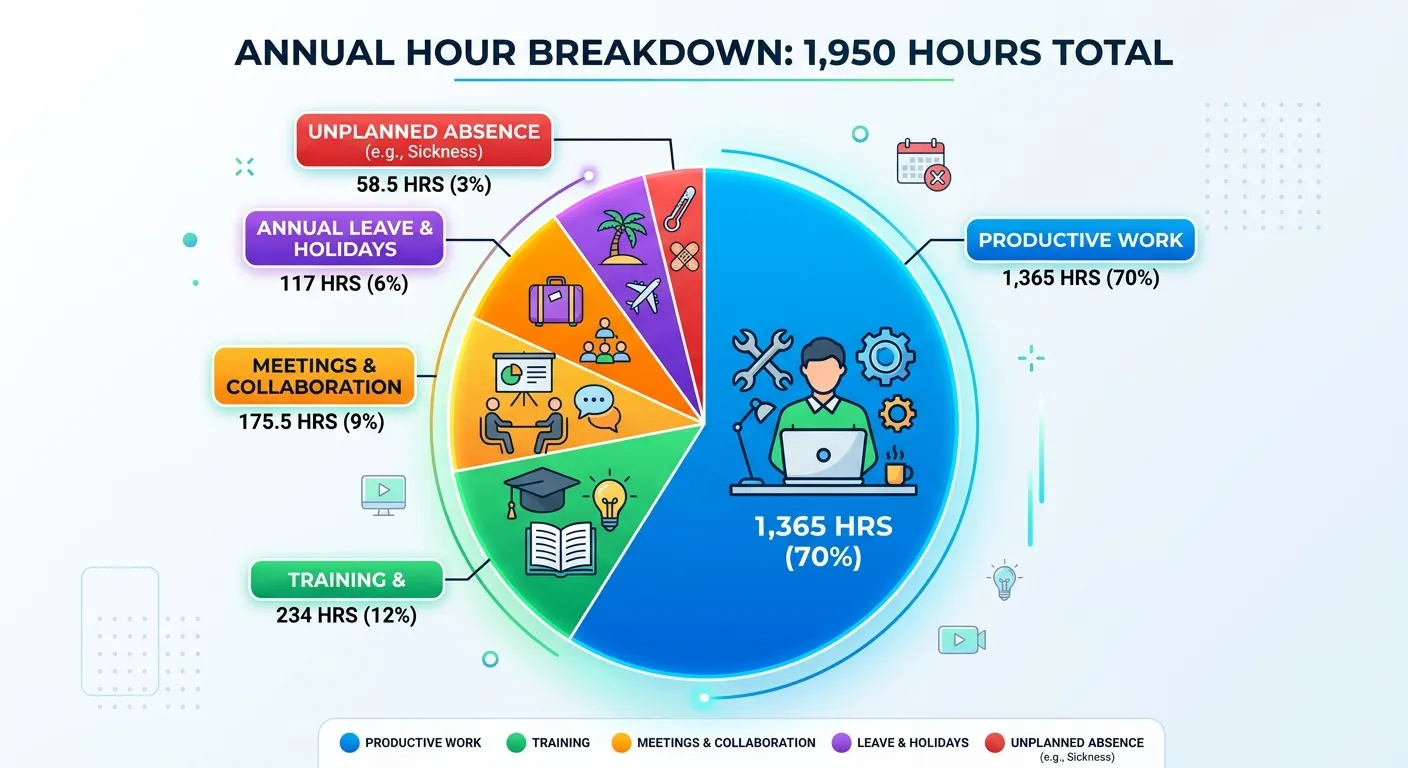
Pro Tip: For precise payroll and project costing, use the net working hours formula: (Weekly Contracted Hours × 52) - (Total Annual Leave Hours). For a 37.5-hour week with 25 days leave, this is (37.5 × 52) - (25 × 7.5) = 1,950 - 187.5 = 1,762.5 net productive hours.
Accurate calculation is the bedrock of effective workforce solutions, preventing both understaffing and unnecessary labour costs. Partnering with an agency that understands these nuances, like our top UK recruitment firm, ensures your staffing model is built on accurate data.
The Hidden Cost of Miscalculating Annual Hours
Inaccurate projections of Full Time Employee Hours Per Year don't just cause payroll errors. They lead to chronic understaffing, employee burnout, missed project deadlines, and unexpected agency temp costs to fill gaps. The financial drain from reactive hiring can be immense.
Expert Insight: We often see businesses with a theoretical 1,820-hour model but a reality of 1,650 productive hours due to unplanned absenteeism, training, and meetings. This 170-hour gap per employee represents a ~9% productivity loss. Proactive workforce planning with a partner like Team Staffing bridges this gap through accurate forecasting and blended workforce models.
Optimising Your Annual Workforce Plan
Step 1: Conduct a Detailed Workload Analysis
Before you can determine the right number of Full Time Employee Hours Per Year you need, you must map your business's workload. Analyse historical data, project pipelines, and seasonal trends. For example, a kitchen porter recruitment agency knows demand spikes in Q4 for the hospitality sector. This analysis reveals whether you need stable, year-round hours or a flexible buffer.
Step 2: Choose the Right Employment Mix
Not all required hours should be met with full-time permanent staff. The modern approach is a blended workforce:
- Core Full-Time Staff: For essential, consistent functions. Provides stability and institutional knowledge.
- Part-Time & Flexible Staff: Covers regular but non-full-time needs, ideal for roles in part-time recruitment.
- Temporary & Contract Staff: For specific projects, seasonal peaks, or covering leave. This is where a reliable Recruitment Services Agency becomes invaluable, providing quick hire access to vetted talent.
Step 3: Implement Robust Tracking & Management Systems
Use HRIS (Human Resource Information Systems) or specialised workforce management software to track actual hours worked against planned Full Time Employee Hours Per Year. This real-time data allows for agile adjustments, such as bringing in temporary warehouse staff during an unexpected surge in orders. It also ensures compliance with the Working Time Regulations.
Case Study: From Fixed Overhead to Flexible Capacity
A mid-sized UK logistics company was struggling with the high fixed cost of 50 full-time drivers, each contracted for ~1,820 annual hours. Demand, however, fluctuated by 30% monthly. They were burdened with idle time in low periods and costly overtime in peaks.
Solution: In partnership with our logistics recruitment experts, they restructured. They retained 35 core full-time drivers and used our delivery driver agency to provide a flexible pool of 15-20 temporary drivers for peak weeks. This transformed fixed cost into variable, manageable capacity, aligning Full Time Employee Hours Per Year directly with business need and boosting profitability.
Frequently Asked Questions on Annual Hours
The standard is based on a 35 to 40-hour workweek. A common benchmark is 1,820 hours annually (35 hrs × 52 weeks). However, for a 37.5-hour week, it's 1,950 hours. Crucially, this is gross hours. Net productive hours are lower after deducting statutory leave (5.6 weeks), public holidays, and other absences. For precise planning, especially when using a Recruitment Services Agency, always calculate based on your specific contract and policy.
If your business requires a consistent, year-round need close to 1,820 hours for a specific role, a permanent hire is likely cost-effective and builds continuity. If the need is seasonal, project-based, or fluctuates significantly (e.g., requiring 800 hours one quarter and 200 the next), temporary or contract staff via a temp agency are more efficient. This flexible model converts fixed labour costs into variable ones, optimising your spend on Full Time Employee Hours Per Year.
Three critical mistakes are:
1. Forgetting Non-Productive Time: Only counting"at-desk" hours and ignoring leave, training, and admin.
2. Ignoring Overtime Costs: Underestimating workload leads to unplanned overtime, distorting true annual labour costs.
3. One-Size-Fits-All Approach: Applying the same hour model to a construction site manager and a hotel receptionist, despite vastly different shift patterns and peak times. Specialist Recruitment Services Agency partners provide industry-specific modelling to avoid these pitfalls.
A proficient agency acts as a strategic extension of your HR function. They can:
• Provide Benchmarking Data: Offer insights into standard and actual Full Time Employee Hours Per Year in your sector.
• Design Flexible Workforce Models: Advise on the optimal mix of permanent, temporary, and part-time hours to meet your demand curve.
• Supply On-Demand Talent: Quickly fill hour gaps with pre-vetted temporary staff, from HGV drivers to payroll administrators.
• Ensure Compliance: Manage time tracking and right-to-work for temporary staff, mitigating your legal risk. Our 24/7 helpline service is specifically designed to support such strategic workforce management.
Ready to Transform Your Annual Workforce Strategy?
Mastering Full Time Employee Hours Per Year is more than a calculation—it's a strategic advantage. It leads to optimised staffing, controlled costs, and a resilient, agile organisation. Whether you need to hire core permanent staff, build a flexible temporary pool, or get expert advice on workforce planning, we are here to help.
As a leading UK Recruitment Services Agency with deep expertise from London recruitment to nationwide staffing solutions, we provide the data, talent, and strategic partnership to turn your annual hours from a cost centre into a driver of growth.
Let's build a workforce that works perfectly for you, every hour of the year.
```
Beyond the Basics: Advanced Annual Hour Modelling
While the standard calculation provides a starting point, sophisticated workforce planning requires modelling for real-world variables. This includes accounting for non-productive but essential time, such as mandatory training, team meetings, and professional development. For instance, a business investing in upskilling its factory production staff on new machinery must factor 20-30 annual training hours per employee into its capacity planning.
The"Utilisation Rate" Factor
No employee is 100% productive for every contracted minute. The utilisation rate—the percentage of paid hours spent on revenue-generating or core tasks—is crucial. An 85% rate on 1,820 annual hours means only 1,547 hours of direct output.
Industries like legal staffing or consultancy bill by the hour, making this metric vital for profitability. Understanding this helps in setting realistic project timelines and client expectations.
Modelling for Absenteeism & Turnover
Planned leave is one thing; unplanned absenteeism is another. The UK average is around 4-6 sick days per employee annually. Advanced modelling includes a contingency percentage (e.g., 2-5%) over the net annual hours to cover this gap, preventing project delays.
Furthermore, the cost of turnover includes the lost productive hours during a role's vacancy and the ramp-up time for a new hire, which can be 3-6 months. Proactive retention strategies, informed by hour-based workload analysis, are more cost-effective than constant re-hiring.
Technology's Role in Precision Hour Management
Modern software solutions have transformed how businesses track and analyse Full Time Employee Hours Per Year. These tools move beyond simple timesheets to provide predictive analytics and integrated workforce planning.
Integrating HRIS with Operational Data
The most powerful models connect HR systems with sales pipelines, project management tools, and seasonal demand forecasts. For a retail staffing agency client, this could mean automatically triggering requests for temporary shop staff when till data predicts a 20% sales increase in the coming fortnight, directly translating sales forecasts into required annual hour increments.
This integration allows for"what-if" scenario planning. Managers can simulate the impact of winning a new contract or launching a product on their annual hour requirements, making staffing a strategic, data-driven decision rather than a reactive cost.
Real-Time Analytics & Alerts
Advanced systems monitor actual hours worked against the planned Full Time Employee Hours Per Year model in real-time. They can flag potential compliance risks (e.g., an employee approaching the 48-hour weekly limit) or operational issues (e.g., a department consistently exceeding its projected overtime budget).
These alerts enable proactive management. Instead of discovering a cost overrun at quarter's end, a warehouse manager can see in Week 3 that order picker hours are trending 15% above forecast due to higher-than-expected orders and can consult immediately with their recruitment partner to adjust the temporary staffing plan for the following month.
Global Perspectives: How Annual Hours Compare
For multinational companies or those competing for talent internationally, understanding global variations in annual working hours is essential. The UK's ~1,820-hour baseline sits within a wide spectrum, influencing everything from cost-per-hour calculations to employer value propositions.
| Country | Typical Full-Time Annual Hours (Net of Leave) | Key Implications for UK Employers |
|---|---|---|
| United States | ~1,780 - 1,850 | Similar hourly output, but often with less statutory leave, affecting well-being and burnout rates. Can create expectations for longer hours in UK subsidiaries. |
| Germany | ~1,330 - 1,400 | Significantly fewer annual hours, often with higher hourly productivity. Presents a competitive challenge in attracting talent in fields like engineering, where work-life balance is a key differentiator. |
| Japan | ~1,700 - 2,000+ | Cultural norms can lead to very long hours. UK-based teams collaborating with Japanese offices must manage expectations around availability and project timelines. |
This global context is vital for businesses using a Recruitment Services Agency to hire remote international contractors or set up overseas teams. It ensures that contracts, expectations, and productivity models are aligned with local norms, avoiding cultural friction and underperformance.
The Future of Work: Evolving Annual Hour Models
The concept of a fixed Full Time Employee Hours Per Year is being challenged by new working patterns. The rise of hybrid work, the four-day week, and outcome-based contracts are shifting the focus from time spent to results delivered.
The Four-Day Week & Annualised Hours Contracts
Trials of the four-day week (100:80:100 model – 100% pay for 80% time with 100% output) compress the traditional annual hours into fewer, more intense days. This requires meticulous re-planning of workflows and client coverage. For example, a customer service department adopting this model might use a customer service staffing partner to provide overlapping temporary cover on core weekdays to ensure uninterrupted service.
Annualised hours contracts are another growing trend, particularly in sectors like education, healthcare, and utilities. Here, an employee's total annual hours are agreed (e.g., 1,820), but their weekly schedule fluctuates based on demand. This provides immense flexibility for employers but requires sophisticated rostering software and clear communication. A Recruitment Services Agency can be instrumental in sourcing candidates who value this kind of flexibility.
Case Study: Adopting a Hybrid Annual Model in Tech
A scaling UK tech startup found its standard 1,950-hour model ineffective. Its developers were most productive in deep-flow blocks, while its sales team had activity-based cycles aligned with US time zones.
Solution: They implemented a tiered annual hours framework:
- Core Functions (Devs): Moved to a 1,720-hour annual cap with complete daily autonomy, focusing on sprint deliverables rather than clocked hours. This boosted innovation and retention.
- Client-Facing Teams (Sales/Support): Maintained a 1,820-hour baseline but with flexible scheduling, using a specialist IT staffing agency to provide weekend and evening cover for global clients without imposing rigid shifts on all staff.
The result was a 22% increase in developer productivity and a 15% improvement in client satisfaction scores, proving that a nuanced, role-specific approach to annual hours is a key competitive advantage in the war for talent.